Tuesday, August 30, 2011

Tug of War: Greed vs. Fear

In my journey of investing in the stock market, I realize now that the most difficult aspect of investing is not the technical evaluations (i.e. P/E, valuation models, CAPM or the ilk). The most difficult thing about investing is managing one's emotions!

Predominantly, it's about managing two conflicting emotions that are often two sides to the same coin. Namely this consists of both FEAR and GREED. I shall start with the emotion of FEAR first.

Fear
Fear is the state of mind where one is afraid. There is a mind-numbing feeling of paralysis. It is a situation where one thinks... "I know what I should be doing but... somehow, I'm not doing it". I freely admit that my personality falls into this category. The fearful investor is one that DISLIKES losing, meaning any losses, even on paper is a painful experience.

If you are the fearful type of investor, then it is important to remember the following:

(a) The Price of Inaction
We are no longer in the age of stability. This is the age of chaos where volatility and change is the only constant. Much like the chaos during the Three Kingdoms era at the end of the Han Dynasty, the price of inaction is defeat. One must seize the day when the time is right. To do nothing is safe but the price that one pays might be the death by a thousand cuts. If you've through research and analysis, then one must be persistent enough to commit to it. Nothing comes without risk. Inaction itself, is a form of risk. In financial terms, it is a slow death through inflation.

(b) Know Thyself, Know Thy Enemy
 In Sun Tzu's Art of War, it is said that:
 "Know Thyself, Know Thy Enemy, A Hundred Battles, A Hundred Victories"

Trying to apply this in stock market investment is not an easy task. However, NOT applying this principle in stock market investing may lead to disastrous consequences. Earlier in 2009 at the height of the Financial Crisis, I performed quite a number of financial analysis on the value of certain counters on the Bursa. Even though I found a number that was quite undervalued, I only invested in a small portion of my cash in them. Why? Fear.

Upon hindsight, I realize that although I knew the Enemy ... meaning I performed a reasonably detailed financial analysis, I failed to know Myself. Self-doubt, paralysis and pride (i.e. fear of losing) caused me to let the opportunity slip by. It's a costly mistake, but one that I'm determined to learn from.

(c) Remember the Simile of the Lute
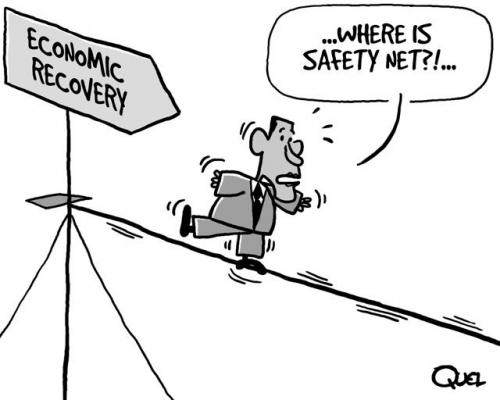
Both Fear and Greed are servants to the Mind. The servants should not control the Master. The wise one is one who can master both these servants to his advantage. In investing, it is as difficult as walking on a tightrope whilst being pulled on either side by both Fear and Greed. In times like this, the best principle I can think of is to abide by the Buddha's advice., that is to follow the Middle Path of Moderation.

"The Buddha once had a disciple by the name of Sona who practised meditation so intensely that he could not progress in his meditation. He began to think of abandoning his life as a monk. The Buddha, who understood his problem, said to him, "Sona, before you became a monk you were a musician". Sona said that was true. So the Buddha said, "As a musician which string of the lute produces a pleasant and harmonious sound. The over-tight string?" "No," said Sona, "The over-tight string produces an unpleasant sound and is moreover likely to break at any moment." "The string that is too loose?" Again, "No, the string that is too loose does not produce a tuneful sound. The string that produces a tuneful sound is the string that is not too tight and not too loose." So here the life of luxury is too loose, without discipline."


Conclusion:
This post should serve as a reminder that one should neither be TOO prudent nor TOO greedy irregardless whether it is good times or bad. A clear mind is the greatest asset can possess in investing. Neither technical knowledge nor insider information can be equal to that.

Friday, August 19, 2011

Tis' The Silly Season Upon Us Again

All the turmoil in the current stock markets recently comes as little surprise to me. Nor should it surprise anybody else. Well, unless you're one of those avid followers of the mainstream media. It's really impossible that the US could recover so quickly from the 2008 financial crisis within a short period of one or two years. Real economic recovery requires time since manpower has to deployed, industries restructured and capital redirected amongst other things. After all, if it takes years to grow a tree, why should the 'real' economy be any different? The faster the US and the whole world faces up to the fact that we're all going to slip into a deep recession for at least 3 to 5 years, the better.

Capital Preservation?
The most painful observation that one must make right now is that Speculators/Gamblers are being given free reign over the Global Economy. What do I mean by that? Well, simply put - the people with capital/cash are no longer being compensated via interest. In other words, the Government wants you to either be in debt or to put your cash elsewhere. These negative returns on capital - after accounting for inflation is pushing everybody into speculating into all sorts of assets. This will merely fuel bubbles into assets such as property, stocks, gold and other assets. Preserving capital alone has become a difficult if not monumental task. 

Is all of these because the Government wants to help entrepreneurs? Not really. Most governments, including Malaysia are running on a deficit. Meaning expenditure is more than income. The Government has to borrow to make up for the shortfall. If you're the Government and have borrowed a lot of money, would you prefer interest to be high or low?

The Price of Inaction
Being an extremely risk averse person, I used to think - why bother? Preserving capital via Fixed Deposits would be sufficient to weather the risk. I no longer think so, since there is a real risk of Hyperinflation on the horizon. Meaning that if the Government keeps on printing money, inflation can go up to astronomical levels. Whilst it is inadvisable to panic over the financial turmoil, one must not be oblivious to it as well. We might well see extreme volatility over the next one year. It would be wise not to put all your eggs in one basket even if it be the almighty cash/ringgit. If there is a Depression, then there might be great opportunities ahead. Conversely, if there is Hyperinflation, there are great risks ahead.

Either way, take this as a friendly advice -  Do your Research, Be Prepared and Diversify. Rocky times are ahead of us.

Sunday, June 6, 2010

Malaysian Mottos Makes Me Loco


Seperti ilmu padi hampa, makin lama makin mencongak
Loosely translated, this Malay proverb means ‘Like an ear of corn which grows tall in proportion to its emptiness’. The more one is puffed up with pride, the more likely that one’s achievements is just full of hot air. If we apply this to the length of letters in our slogans, it just shows how ‘tall’ we have grown. The more lavish our slogans, the more ludicrous records in our very own Malaysian Book of Records - the more ‘empty’ and ‘hollow’ our lives become.

Life in Malaysia is quite amusing at times. One inescapable fact of life is that when there is a change in the top leadership, a massive public relations campaign is mounted, spearheaded by catchy slogans promising ‘change’. Unfortunately, the nation seems to be headed in the OPPOSITE direction promised by these slogans. ‘Talking the talk’ is what we have come to expect from politicians. Not ‘walking the talk’ is also understandable. However, when one ‘talks one way, walks the opposite way’ or ‘Cakap Tak Serupa Bikin’, things becomes unbearable.

Bersih, Cekap dan Amanah
What does this motto mean? Loosely translated, it might mean Clean, Proficient and Trustworthy. Simply put, let’s just say it means ‘No Corruption’. Well, have we succeeded in reducing corruption in Malaysia? Let’s use the Corruption Perceptions Index by Transparency International as a measure.


Ooops… it appears that Corruption is actually on the uptrend rather than being reduced. See what I mean?

Cemerlang, Gemilang dan Terbilang
Excellence, Glory and Renown. A fantastic slogan that conjures up images a Golden Age filled with Emperors, Heroes and Glorious Armies of a long lost age. Perhaps one could use such words for the ancient Roman Empire or the Tang Dynasty. But for Malaysia? Is this realistic? A slide from PEMANDU should suffice.

So much for Excellence, Glory or Renown . Perhaps it is true that ‘Those whom the Gods would destroy, They first make Proud’?

One Malaysia. People First, Performance Now
Gee! This sounds quite swell. Finally a motto that actually makes sense. Now, if only the ruling Government could follow through on this one. Unfortunately, the walk has been in the opposite direction. Don’t believe me? Look at the picture below.


Conclusion:
Nobody minds good mottos, especially ones that we can believe in. However, let’s have honest mottos that we can rally behind and work towards. How about an eminently more sensible motto on what Malaysians needs? (with apologies to William Boyd "Bill" Watterson II)


Kick MY Butt!

Thursday, June 3, 2010

Lies, Damned Lies and Statistics

On 27 May 2010, Idris Jala, CEO of Pemandu presented the Government’s justification for the proposed removal of subsidies. The presentation can be downloaded here. Today, we all the mainstream newspapers interviewing Idris Jala and allowing him to explain his views further here. It seems eminently reasonable to remove the subsidies, if you are one of those that lack a thinking cap. Once you think hard enough though, something appears to be wrong with this picture.

Interesting Headlines but …
The Government tells us that we, Malaysians must be swimming in the lake of milk and honey all this while. In Bolehland, prices are the lowest and life, the rosiest. We have enjoyed living in luxury via generous government subsidies and now the party’s over. No more Bolehland … time to return to the ‘Real World’. Well, this appears to be strange. The cost of living appears to have gone UP these past few years but … well, the picture above seems to imply otherwise. Is what is being said true?

An Independent Analysis
Let’s use the Internet to do a simple, independent analysis, shall we? The analysis below is a review of the cost of living between Malaysia and Singapore, using Numbeo, a free Internet database about the cost of living worldwide. Why Singapore? Well, that tiny little speck south of Johor was once part of Malaysia. We are both geographically and culturally similar. Since Bolehland has the lowest prices in the region, we would expect our cost of living to be significantly LOWER than Singapore, right?

Using Numbeo, we can compare the prices of food in Malaysia and Singapore in USD as well as our median monthly disposable income. Let’s look at the numbers below (click on the picture to enlarge it):
Hmmm.., food costs twice as much in Singapore (USD510) as compared to Malaysia (USD268). So, it is true that we are paying much less for food due to subsidies paid for by our Government. However, let’s not forget the MOST important fact. The average median monthly disposable salary of Singaporeans of USD2.2K is more than twice that of Malaysians, USD0.9K. Singaporeans only have to fork out 22% of their disposable salary on food. However in Malaysia, we have to fork out 27% of our disposable income for the same foodstuff. Although this analysis is imprecise, it is sufficient as an indicator that our cost of living is higher than Singapore. Further, this high cost will only go UP if we agree to the subsidy hike.

So, if the Government goes ahead and removes the subsidies on subsidized goods and fuel, inflation is projected by the Government to increase to approximately 5% per annum. This will be compounded by an additional 5% Goods and Services Tax by the Government. To maintain the same lifestyle, Malaysians will have to fork out an additional 3% (or more) of their hard earned (might I add, measly) salary for food alone.

The main question we should be asking is WHY there is such a HUGE disparity in the quality of life enjoyed by Singaporeans compared to Malaysians? Why is the Government portraying Malaysia as the land of milk and honey? Even BEFORE the subsidies are removed, our cost of living is already substantially higher than the Singaporeans. Let’s not forget that Singapore is a country with almost non-existent natural resources and lacks the economies of scale that Malaysia possesses.

Conclusion
Surprisingly, based on PEMANDU Open Day polls, over 90% of the attendees are ‘happy’ with the proposed subsidy removal. And that is being used as one of THE main justification to remove the subsidies. The very Government that put into place this subsidy mechanism, spent beyond its' limits and wasted billions in white elephants projects and bailing out GLCs is asking us for more money. They promise that it will be used wisely to increase our monthly income, eventually. I say, let’s wait for PIGS to fly and hope that we don’t starve to death in the meantime.

Saturday, May 29, 2010

Propaganda: Malaysian Style


The maxim that ‘If you tell a lie big enough and keep repeating it, people will eventually come to believe it’ appears to be the driving principle behind the public relations effort by our Malaysian Government over the proposed removal of the subsidies. The official ‘story’ such as the one by Sin Chew entitled ‘The Malaysian Dilemma’ exemplifies this. Here is an extract:

If Malaysia's economy can expand robustly over the next couple of years, and our incomes grow significantly with the wealth gap narrowed concurrently, then the ensuing pains from subsidy cuts will be diluted.

Very simple. The subsidies North Korean government has provided to its citizens are perhaps the most generous in the world, but with appallingly low incomes, the people remain impoverished despite the generous government subsidies. In contrast, South Koreans can still enjoy very comfortable lives without the generous handouts from the government, because they have very high incomes.

As a matter of fact, our government needs not worry about subsidy cuts. More importantly, it must implement policies that will enhance economic growth, improve government efficiency, while cutting down unnecessary red tape and corruption so as to boost investor confidence.

Subsidies will no longer be that important once our per capita income becomes doubled.

Since this is an issue that concerns our livelihood, we should ‘THINK’ and see how ridiculous the argument above is.

IF, If and if
Reading the first paragraph implies that our economy has been stagnating, our income has shrunk and the wealth gap between the poor and the rich had grown substantially during the past decade.

Albert Einstein once quoted that ‘Insanity: doing the same thing over and over again and expecting different results.’ So, let me ask you a simple question. How confident are you that the people that led our country on this financial precipice can find the courage, vision and wisdom to reverse our downturn and lead us onto a different path?

Subsidies Sucks
Is it true that subsidies are the bane of economic wealth? This article seems to imply that subsidies are the reason behind the decline of North Korea’s economy whereas the prosperity of the South Koreans is due to lack of subsidies. This is like comparing an apple with an orange. North Korea is under a dictatorship with substantial military spending. Further, with economic sanctions imposed on it by the United Nations, it is little wonder the country is suffering economically. To imply that subsidies are the reason for the poverty of the country is cheeky, to say the least.

Government Initiatives
The article goes further and states that the Government needs not worry about the cut in subsidies since ‘subsidies will no longer be that important once our per capita income becomes doubled’. Is this supposed to be a joke? Do you see the twisted logic here?

What the article is actually saying is that with the cut in subsidies, the Government will finally implement policies that will enhance economic growth and cut down on red tape and corruption. Of course, this implies that the Government has failed in implementing sound policies on economic growth for decades. Red tape and corruption have been allowed to flourish until we stand at the very edge of financial ruin.

The crux of the argument by the Government is that the subsidies are a waste of money. And that they are better used elsewhere to fuel economic growth of our country. We are now being asked to hand over more money to the people that created this mess in the first place. Now that’s really insane.

Conclusion
Whilst the Government is to be lauded with coming clean about the dire financial situation Malaysia is in, one should wonder whether it is too little, too late. Critical analysis and constructive suggestions such as ‘Economic tsunami heading our way’ by Dr Lim Teck Ghee is most instructive. What we don’t need is non-sensical propaganda saying ‘Yes’ to every government initiatives especially one as detrimental as removal of subsidies. Added with the proposed Goods and Services Tax (GST), these are really dire times ahead for Malaysians.

Thursday, May 27, 2010

When the Going gets Tough, The Tough gets Going

Today, as I skimmed through the headlines of our newspaper, three very interesting headlines caught my eye…

‘Malaysia government plans fuel and other subsidy cuts to avoid becoming bankrupt by 2019’

‘Sime defends business model after Q3 loss’

‘Malaysia's 40 Richest Wealth Soars 42 Per Cent To US$51 Billion’


Malaysia Boleh or 'Tidak Apa' Attitude
It is said that we often get what we deserve, and I believe that is true of our elected Government as well. The very fact that most Malaysians don’t even bat an eye at the excessive spending of our Government on lavish and often uneconomical projects such as the PKFZ projects is astounding.

The fact that the Government has admitted it may follow Greece into bankruptcy is a serious wake up call. Yet, even with the proposed removal of subsidies and implementation of Goods and Services Tax (GST) – I doubt Malaysia can remain in the black. These suggestions are an attempt to treat the symptoms of the disease but not the underlying reason.

The Buddha once cautioned that:

‘Just as in the case of a great tank with four inlets and outlets, if a man should close the inlets and open the outlets and there should be no adequate rainfall, decrease of water is to be expected in that tank, and not an increase’

Our Government seems to have taken Buddha lessons to heart. On one hand, its’ increasing its’ inlet [income] by raising new taxes such as GST and removing subsidies for the public. But will it do any good if it continues to spend, spend and spend by opening the outlets to the tank?

Proposed Goods & Services Tax
One, the Government is running out of money. Two, GST is supposed to bring in additional ‘moolah’ for the Government. Three, the Government says that taxes will actually be less under the GST and will not unduly burden the lower income and middle class.

So, where do you think the additional money for the Government is going to come from? Some of you might think – yeah, it will come from the upper class. Are you kidding me? The Income Tax that we pay via our Borang BE is by far, a more equitable system. If you earn more, you pay more to the Government. So, why doesn’t the Government increase the tax rates under Income Tax instead of using GST?

Simple, under the GST, the tax burden shifts more to the poor than the rich. Heck, the rich can afford to pay a measly 5% tax on that flashy handbag but to tax an additional 5% on a packet of nasi lemak may be too much on the poor. Forget about price controls! And if the Government tries to institute price controls on certain controlled items after the implementation on GST – well you might pay the same price for your packet of nasi lemak – but it may have shrunk by half.

Remove Subsidies and then what? [Spend, spend and spend?]
Typically, our official media has portrayed the Government as being responsible in highlighting the issue and trying to resolve it with public input. Hogwash! And we are missing the big picture here. It’s all fine and dandy to want to remove the subsidies to the public but what about the rest of the Government expenditures.

Firstly, isn’t the Government a little bloated? I am sure a large % of the government expenditures goes towards paying for the salaries of our civil servants. Hmmm… private entities usually ‘downsize’ in times of difficulties. What about our Government?

Secondly, why are we in this situation in the first place? Where have our vast natural resources such as timber, fertile land, petroleum etc. gone? If the Government is going to continue to sink our money into white elephants – I prefer the money go into subsidies rather than beasts such as PKFZ.

Thirdly, when are we going to stop bailing out GLCs such as MAS, Sime Darby and Proton? Sure, remove the subsidies if you want to – but please remove the excessive and ludicrous tax on foreign cars as well.

Conclusion
Often, it takes two to tango. If the Government wants the public to bear the burden of its’ fiscal deficit by removing subsidies – we want some accountability as well. How about some real effort in eliminating leakages and white elephants? What’s the point of saving a couple of billion in subsidies and squandering them later on. Can we also have more transparency such as releasing detailed financial statements of Petronas?

Saturday, January 16, 2010

Philosophical Musings - Part XXVIII

The Roots of Wisdom


As I laid in bed, struck with a serious illness over the past month - I realize just how fragile my life really is. There is nothing like the threat of my life being forcibly taken away for me to really comprehend how attached I am to this life I'm leading. Taking care of one's health may sound cliched but it's better than being bedridden for a month. Though I've lost a month, I've gained a new found appreciation for life and my health. There's nothing like Calvin's proverbial advice - a good swift kick in the butt is what I need to get going. And that reminds me on Hong Yingming's verse on the roots of sorrow below.

The Roots of Sorrow


The Diseases of Old Age
Are all incurred at the time of our Youth


The Adversities that overtake us after we start to decline
Were all created at the time of our Prosperity


Therefore, when the Gentleman is enjoying Status & Fortune
He is extremely apprehensive

Saturday, September 26, 2009

Philosophical Musings - Part XXVII

A Stranger Knocks on the Door


As I lay there
In the warm embrace of my veil
The air suddenly turns frigid
Chills tingle up my spine

I hear a knock on the door
So soft, almost like a chime
So methodical, almost like the
Sands of Time

The veil of Ignorance
Is ripped to shreds
And what is left
Is something awkward?

For who is the visitor
That knocks?
A hooded, shrouded figure
That offers the sweet temptation of Finality

A sense of panic
Courses through my entire body
As I shudder and wake up drenched in fear
What is the meaning of this?

I run away
Grasping at the tattered remains of the veil
But how long can I flee?
And where is the haven that I seek?

Friday, July 3, 2009

Am I Gambling or Speculating Intelligently?

As I observe the market movements of certain stocks listed on our Bursa Malaysia, I begin to discern that the ups and downs of the market are highly erratic and somewhat illogical. In fact, there are times when I wonder whether I have entered into a gambling den where my gains or losses are based on the whims of Lady Luck rather than on my analysis of the fundamentals of these companies.

For instance, look at the shares of Genting Berhad below. The share price has almost doubled within the span of three months from March to June 2009 i.e. RM3 per share to RM6 per share.


However, when one takes a long hard look at the financial results, you will find that there’s really nothing optimistic about Genting that can justify the doubling of its’ share price. In fact, the results are quite disappointing. Why then has the price gone up?


Should you have bought Genting’s shares in March 2009? You would have made almost a 100% gain within three short months.

STOP!

As an investor, I feel that there is nothing more dangerous than venturing from intelligent speculation to outright gambling.

So, what’s the difference? Just stop and ask yourself this one critical question:

Are there any good reasons to buy the shares in Genting at RM3 three months ago?

Gambling?
If there is none, you are merely gambling away in the Bursa Casino. Yes, in hindsight the price has gone up. But don’t forget, the price of Genting shares could have gone down significantly as well.

Speculating Intelligently?
If yes, take a long hard look at your reasons. Are they based on good and fundamental reasons? Even if you hear rumors that the company will secure a large project, consider the reliability of the information first. More importantly, take a long hard look at the share price of the company for the last few days. Somebody might have already purchased the shares in that counter and are looking to sell it to some naïve investors. Don’t be one of them!

Internal Benchmarks
A more reasonable approach is to use look at the PE ratio or dividend yield of these companies. If the PE ratio is less than 10x or dividend yield is 8% or more, it may be a good investment. Further, do your own homework and assess the liquidity and gearing of such companies before investing in them.

Conclusion:
Try not to buy shares of companies just because its’ prices are going up. And don’t sell shares you hold, just because the prices are going down. Following the crowd will get you nowhere except losing your hard earned money. Make sure you have good solid reasons for investing in the first place and equally good reasons before selling the shares that you own.

Monday, June 15, 2009

Stupendous Stocks - Part I

Malaysian Airline System Berhad

In this series of posts, I will be looking at some of the more incredible gyrations of stocks in Bursa Malaysia. For want of a better word, let’s call them ‘Stupendous Stocks’ named after a certain superhero.

Surely, the most stupendous stock today is none other than Malaysian Airline System Berhad (MAS), stock ticker: 3786. On 12 June 2009, MAS finally announced its’ quarter one results for 2009 which was delayed due to its’ early implementation of FRS139: Financial Instruments, Recognition and Measurement. FRS139 is an incredible complex standard which aims to do a simple thing: i.e. reflect the gains/loss in investments by benchmarking them against market prices (i.e. marked-to-market accounting).

And the impact of this fantastic piece of accounting:

1. Quarter 1, 2009: Derivative loss of RM557mil
2. 2008 and prior: Derivative(?) loss of RM3,952mil

The total impact of FRS139 is a net loss in derivatives of approximately RM4.5 BILLION. Is this a lot of money? Hmmm…. Let’s look at the shareholders equity, shall we? Ooops, is there any shareholders’ equity left? Total equity is a NEGATIVE of RM446 million.

Granted, these losses are unrealized losses. It’s the same as me saying that just because I bought Transmile stocks at RM10 in 2006, I don’t have any losses since I haven’t sold any. Even though its’ only worth RM1.46 today, it doesn’t mean it won’t go up to RM10 in the future, right? Right on… it must be this sort of thinking that explains why the price of MAS has hardly moved today. Perhaps RM4.5 BILLION LOSSES is just insignificant compared to the MAS’s cash balances of just over RM2.9 BILLION? For those of you who can figure this out, I salute you!


For the others, welcome to the wonderful world of investing in our ‘Baffling Bursa’!

Friday, June 12, 2009

Philosophical Musings - Part XXVI

My Search for Meaning


Once … long past
I believed in the world
Accepted life without questions
Without doubts

Now
Questions abounds
Burning …
Unyielding …

Freedom …
Free to think
Free to ponder
Free to question

My mind
Like a whirlpool
Swirling
Unceasing

Some place faith
With God
Though
I will not

No haven
No shelter
Only the sinister
Light of the cold, harsh truth

Why must I end?
If so, why do I exist?
Why did I begin?
If so, why am I unaware?

Monday, June 1, 2009

Philosophical Musings - Part XXV

Reflections on the Winter of My Soul


In the silence of the Night
I sit here alone
And I ponder
On Life

What is clearly Black or White …
Has turned into shades of Grey
What is evidently Right or Wrong …
Has become mired in lies

When Trust is betrayed
It pains one’s Soul
More than words can say
More than the heart can bear

A shadow has fallen
Across the arid landscape
Lost …
Forever?

One day
The journey must end
I know naught what the future holds
Will I one day too, be forsaken, forgotten and forlorn?

Monday, February 16, 2009

Financial Intelligence - Part XX

Golden Dreams, Ironic Reality


Just like Pyrite, commonly referred to as ‘Fool’s Gold’, the allure of investing in the stock market is just as irresistible. After all, wasn’t the fortune of one of the richest man in the world today built solely on investing in the stock market? Unfortunately, just as the road to hell is paved with good intentions, the stock market is also littered with many who have lost their fortune by gambling in it. Let us set aside the golden dreams we have of striking the lotto in the stock market and look at the cold ironic reality of investing in the stock market.


[Click on the chart to enlarge it]

Long term Capital Appreciation
The market capitalization of our listed companies in Bursa Malaysia was approximately RM132 billion as at end of 1990. As at end of 2008, this amount has risen to RM664 billion as at end of 2008. Over a period of 18 years, the compounded annual growth rate (CAGR) is a mere paltry 9.39%. Assuming the average interest rate of fixed deposit during this period was 4%, the stock market yielded only an additional return of approximately 5% for the risk taken.

Gross Domestic Product (GDP) Growth vis-à-vis Capital Appreciation
Briefly, GDP can be considered to be the market value of all the output produced in a nation in one year. Let us consider the nominal GDP growth in Malaysia from 1990 to 2007 (i.e. inclusive of the effects of inflation). Nominal GDP in 2007 was RM641 billion as compared to RM119 billion in 1990. The CAGR over a period of 17 years is 10.41%. There appears to be a strong correlation between the long term growth rates of our GDP versus the capital appreciation of the market capitalization of Bursa Malaysia as a whole. Both have grown approximately 10% per annum over almost a period of two decades. Comparing these two indicators may give us a indication whether the stock market has bottomed out.

Market Capitalization as a % of GDP
A review of this ratio indicates that this ratio has been hovering between 1.0x to 3.6x from 1990 to 2008. The ratio was at its’ peak at during the Bull Run in 1996 just prior to the Asian Economic crisis. This may be a good indication that valuations of the stocks listed on the then KLSE were excessive. As indicated in the chart above, at Point A, market capitalization in the then KLSE exceeded nominal GDP by RM553 billion. In fact the value of the entire stock market was three times more than the GDP. Clearly this was unsustainable and more than RM431 billion was wiped out in the stock market crash in 1997.

At the end of 2007 as indicated at Point B, the market capitalization in Bursa Malaysia again exceeded our GDP by RM465 billion. The market capitalization as a % of GDP ratio of 1.73x indicates that stocks were possibly overvalued, although on less excessive scale as compared to 1996.

Where are we now?
Market capitalization as at end of 2008 was approximately RM664 billion. Assuming Malaysia’s nominal GDP grows at a conservative 3% from 2007, 2008 GDP would be approximately RM661 billion. Based on the overall trend, one could say that the Malaysian stock market may have reached attractive levels at the ratio is now at a historical low of approximately 1.0x. However, this may not necessarily be the case. The growth in our stock market from 1986 to 2008 was largely fueled by the transformation from an agrarian industry into a manufacturing industry catering largely to exports to US. With the current US economic recession and the emergence of competing countries including China, Vietnam, Cambodia etc, the Malaysian economy is at crossroads. Our economy may recover, or it may not. So, it would be foolish to extrapolate past trends into the future. Having said that, valuations of stocks on the Bursa Malaysia appears to be reasonably priced at this time and one should consider cautiously entering into the market in 2009.

Thursday, February 12, 2009

Financial Intelligence - Part XIX


Investing in the Stock Market
The above slide illustrates a very CRUCIAL aspect about investing in the stock market. When one begins to invest in the stock market, the most illusory aspect about it all is the relative sense of calm. Stock prices don't move up or down much most of the times. Instead there are long periods of boredom where it increments up and down in minute amounts. Where is the excitement and roller coaster ride I signed up for?

As Jason Zweig points out here,

Nearly all of us try forecasting the market as if each of the past returns of every year in history had been written on a separate slip of paper and tossed into a hat. Before we reach into the hat, we imagine which return we are most likely to pluck out. Because the long-term average annual gain is about 10%, we "anchor" on that number, then adjust it up or down a bit for our own bullishness or bearishness.

But the future isn't a hat full of little shredded pieces of the past. It is, instead, a whirlpool of uncertainty populated by what the trader and philosopher Nassim Nicholas Taleb calls "black swans" -- events that are hugely important, rare and unpredictable, and explicable only after the fact.

History shows that the vast majority of the time, the stock market does next to nothing. Then, when no one expects it, the market delivers a giant gain or loss -- and promptly lapses back into its usual stupor. Javier Estrada, a finance professor at IESE Business School in Barcelona, Spain, has studied the daily returns of the Dow Jones Industrial Average back to 1900. I asked him to extend his research through the end of 2008. Prof. Estrada found that if you took away the 10 best days, two-thirds of the cumulative gains produced by the Dow over the past 109 years would disappear. Conversely, had you sidestepped the market's 10 worst days, you would have tripled the actual return of the Dow.

"Although we could make a bundle of money if we could accurately predict those good and bad days," says Prof. Estrada, "the sad truth is that we're very, very unlikely to do that." The moments that made all the difference were just 0.03% of history: 10 days out of 29,694.

There may be those who are prescient with an ability to gauge exactly when those 10 days are. For the rest of us mortals, it would be better to understand the intrinsic value good companies we are interested in. Wait for those 10 days to appear and have your cash ready to swoop in on them when Mr. Market is an extremely suicidal mood.

Sunday, February 8, 2009

Global Economic Crisis: Who are the Winners?


I don’t know about you but I’m feeling quite depressed nowadays. When one hears about people being retrenched and the spike in the unemployment rates, the blood pressure usually goes up and moodiness sets in. There’s something wrong with this picture somehow and this post is an attempt to answer a puzzling question I have about what’s happening right now.

Physical Wealth
From a global perspective, nothing major has happened in the physical realm that we live in. There were no major wars, earthquakes, tsunamis or any form of massive destruction of our assets, people or resources. I feel that I’m correct to say that if the entire planet’s resources were valued monetarily, there would be no significant changes from 2007 vis-à-vis 2008.

Financial Wealth
From a financial perspective, there has been a major seismic shift originating from the US. Major financial institutions have either collapsed or required government bailouts. These include branded names such as Citibank, AIG and Lehman Brothers. Additional bailout packages are being debated and approved as we speak, to help jumpstart the US economy. The effects of this seismic shift in the US have begun to reach the shores of other countries causing contraction in the major economies of other countries including Europe, Asia, China and Japan.

The Zero Sum Game
One of the reasons why I have always abstained from gambling is because it is purely a zero sum game. If you win, someone else loses. There’s just a transfer of wealth since nothing of value is being created. Let’s compare this with the current crisis. Is there something not quite right here?

The Cake Analogy?

A simple analogy should suffice here. Assume that the global resources of the earth are represented by a cake. Now instead of cutting this cake and handing a slice of this to everybody equally, everybody is given coupons as a claim over the cake. Assume the global population of the world consists of 100 people.

Ever person has a 1/100 coupon. Let’s denominate these 1/100 cake coupons as 1 cake dollar. So, the entire global resources are worth 100 Cake Dollars. Every person has a Cake Dollar and his happy with this arrangement. All these Cake Dollars are being held with ABC Bank Inc. One fine day, ABC Bank Inc says that 60 Cake Dollars have gone missing. Where has it gone? ABC Bank Inc says that’s not important, what’s more important is that it needs all the existing citizens to subsidize the losses. So, it asks the government to print an additional 60 Cake Dollars to make up for the shortfall. Each Cake Dollar is worth 60% less due to inflation. In other words, each Cake Dollar allows the citizens to claim 0.4/100 of the world resources.

Wait a minute here! Let’s see… So 100 persons now have 100 Cake Dollars. The total of these 100 Cake Dollars has a stake of 40% over the world resources due to inflation. Heck, who’s swindled off the remaining 60% of the global resources of the world?

Well, perhaps if you look hard enough, it’s likely that the original 60 Cake Dollars couldn’t just have disappeared, could it? Money just doesn’t disappear into thin air. Most likely, the missing 60 Cake Dollars were cashed out by the winner and he’s just taken the 60% slice of the entire cake from the table. And his gain is at whose expense? It’s the people still holding the Cake Dollars being asked to subsidize for the losses of ABC Bank Inc that’s left picking up the pieces.

How Could the Bank Lose?
As an analogy, assume ABC Bank Inc betted 60 Cake Dollars against *someone* that Roger Federer would win the Australian Open in 2009. ABC Bank Inc lost.

Normally, we would just let this bank fail. You made a bad call, you pay the price. Unfortunately, all the Cake Dollars are held with this bank. If it fails, there would be a run on the bank and everyone would start realizing their Cake Dollars are worthless. So, the 99 persons in the world have to absorb the 60% losses by ABC Bank Inc to avoid starting a world wide panic and riots.

In Real Life
The 2009 Australian Open bet is akin to the gambles taken by the financial institutions in CDOs, CMOs, CDS and the like. How could the derivatives arm of these major investment banks and financial institutions earn returns in excess of 20 or 30% per annum? Only if you play the zero sum game! And when you win big, you can also expect to lose big sometimes. And the banks have lost BIG against someone. The fact they need so much money is that they’ve used the depositor’s money to pay of their bad bets. Now, they don’t have any money left to pay the depositors money they were supposed to hold on trust for us.

As we are talking about huge losses of trillions of USD, *someone* must have made a hefty gain at the expense of the banks and tax payers. In addition, since everyone is feeling depressed, prices of commodities (i.e. real resources) are under priced. This *someone* is going to have a bonanza time taking over commodities and companies at fire sale prices.

Anyone has any idea, who this *someone* is?

Thursday, January 1, 2009

Happy New Year - 2009 :)

Time passes swiftly and silently by. 2008 is history! Here's to wishing all of you a happy and prosperous 2009 :)


Friday, December 26, 2008

Philosophical Musings – Part XXIV

The Roots of Wisdom

Our education system in this modern world is in somewhat of a dire state. Rote learning, memorizing and plagiarizing is becoming rampant. We should be vigilant in educating our young ones on how to understand the true essence of things. Here is the relevant verse from the Roots of Wisdom:

The Essence of Things


People understand how to read books
That have words
But do not understand how to read those
That lack them


They know how to pluck the lute
That has strings
But do not know how to pluck one
That has none

Caught by the form
But untouched by the spirit
How can they obtain
The substance of either literature or music?

Monday, December 22, 2008

Financial Bailouts

Friday, December 19, 2008

Philosophical Musings – Part XXIII

The Roots of Wisdom

In this modern world, it is all too easy to get caught up in our little world. Petty differences and insignificant matters are blown out of proportion. Yet, can we accept the fact that we are merely insignificant beings in the greater Scheme of things? Why not let these troubles and travails go for a moment? Let a verse from the Roots of Wisdom illuminate your Path:

The Highest Wisdom


Mountains and Earth
Are already nothing but dust

While man, of course
Is but dust within dust


Bodies made of blood and muscle
Will surely return to bubble and shadow

While human affairs
Are but shadows within shadows


If the Highest Wisdom is not attained
The Heart will not understand

Wednesday, December 17, 2008

Body Language - Part II

In Part I, we saw the importance of body language in the work place. I’m sure most of us feel that we don’t really need to learn about body language for various reasons. Some of us might feel that we are already quite good at it whilst others don’t know how to begin. Well, why not take a short quiz to see how good you are at interpreting Body Language?

The video below is made up of five segments showing top CEOs of multinational companies being interviewed. Focus on the following:

1. Tone and pitch of voice;
2. Facial expressions;
3. Hand gestures;
4. Posture and overall body language; and
5. Your emotional reaction towards their body language.

The Quiz:


Film 1: Carleton Fiorina (Former CEO of Hewlett-Packard)
1. How would you characterize her from what you have seen? (E.g. tough, soft?)
2. How do you feel about her smiles? (E.g. genuine, forced?)
3. How is she giving emphasis about important things (E.g. head tilted, clenched fist?)
4. Watch the video at 1:34 to 1:39 again. Do you notice anything unusual about her body language?
5. What is the pitch of her voice? (E.g. slow, fast, confident?)

Film 2: Steve Ballmer (CEO of Microsoft)
1. Look at his hand gestures. How do you feel it shows about his character? (E.g. committed, aggressive, confident?)
2. Why do you think he is leaning forward in his chair? (E.g. seducing the audience, trying to establish rapport?)
3. As the audience, how do you react to his body language? (E.g. angry, interesting, boring?)
4. Do you feel he fails to establish rapport with the audience? If yes, why is that?
5. Is he raising barriers between the audience and himself? If yes, what are the barriers that you see?

Film 3: Peter Brabeck (Chairman of Nestle)
1. How would you characterize him? (E.g. all-knowing teacher, smooth-talking salesman?)
2. Do you find him interesting? If so, what captivates you about him? (E.g. voice, demeanor, hand gestures?)
3. Which of his hand gesture best reflects his character?
4. How do you feel about the image that he is portraying? (E.g. interesting, boring, narcissistic?)

Film 4: Steve Jobs (CEO of Apple)
1. How do you about his self image? (E.g. geeky, friendly?)
2. How do you feel about his arm and hand gestures? (E.g. confident, anxious?)
3. What are his worst gestures during the interview?
4. Is he charismatic?

Film 5: Richard Branson (CEO of Virgin)
1. What is your first impression of him? (e.g. anxious, confident?)
2. What could be indicators that he is anxious?
3. Is there anything unusual happening in the video at 9:01?

Overall:
Which of the following CEOs showed the best body language?

Think about these questions and jot down your answers. Spare about half an hour for this exercise if you really want to gauge your ability to read body language. Once you have done so, you can go to the link here to input your answers and obtain the results. I would appreciate if you could share your results and opinions here. Many thanks to anaconda2610 for sharing this with us.

  © Blogger template 'Minimalist G' by Ourblogtemplates.com 2008

Back to TOP